
Subject Lead: Miss Kennedy
Link Governor: Rachel Chauhan
On this page, you can find information about our Maths Curriculum at Front Street.
Subject Aim (Intent):
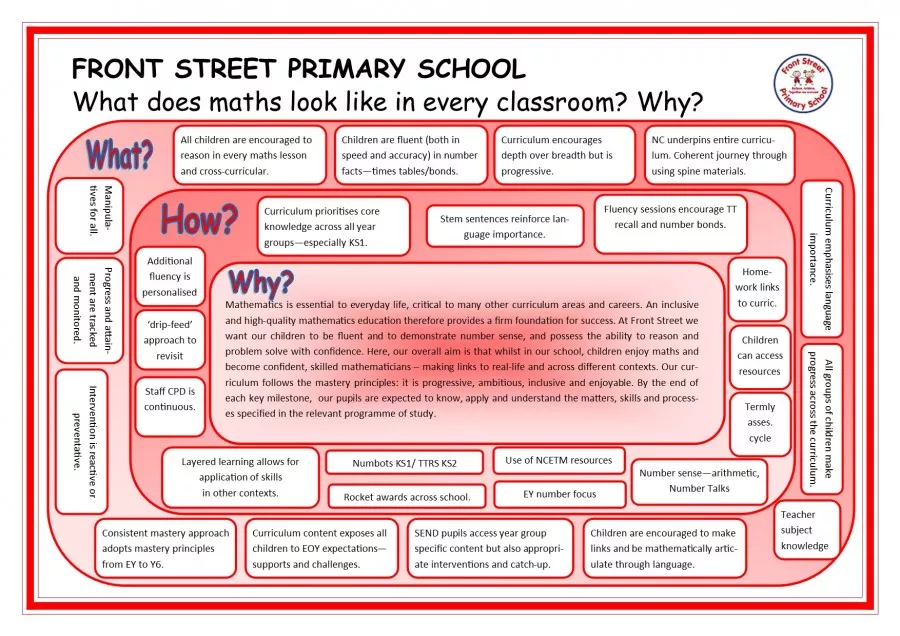
Children enjoy maths and become confident, skilled mathematicians – making links to real-life. Our whole-school curriculum drivers that we promote across all subjects are: ready, relevant, progressive, ambitious, independent, inclusive, resilient.
So…how does this look in maths?
| Ambitious | Have aspirations. Be aware of how fundamental maths is in the real world and why they need to learn the skills. Know about famous mathematicians and aspire to careers linked with maths. |
| Progressive | Maths skills are built on year-upon-year. Children make progress in maths from their starting point. Children learn and have the opportunity to apply new skills. |
| Independent | Children tackle maths independently. They can work in a range of contexts, but have the independence to complete the tasks they are set. Children are not reliant upon others. |
| Inclusive | We have high aspirations for all. We believe, achieve and succeed in maths. Everyone CAN do maths – we do not put a limit on learning. Equity for all through a carefully crafted and cohesive curriculum. |
| Relevant | Maths is meaningful and purposeful. Children develop skills in maths to equip them with functional maths – relevant to real-life opportunities and linked to maths in the real world. |
| Resilience | Our children have a growth mindset in maths: they believe in their maths ability. They can and will achieve and succeed in maths. They solve problems and do not give up. Pupils understand that some maths can be testing, but their mindset enables them to persevere. |
| Ready | All children are taught age-related content. Our maths curriculum is coherent and progressive. Children master their own year-group content to be ready for the next phase in their academic career. |
How the maths curriculum is organised (implementation)
At Front Street, we teach the National Curriculum for mathematics, using the National Primary Guidance and the NCETM Curriculum Prioritisation and Professional Development Materials to support our planning, resourcing and delivery and to also develop teacher subject knowledge. We also track coverage, plan and assess using the local authority Gateshead Core Curriculum. We deliver the core NC aims of fluency, reasoning and problem solving in every lesson.
In response to the impact of the pandemic, the 2021/22 maths curriculum has been prioritised to follow the NCETM Curriculum Prioritisation Materials. This means that there is currently a greater emphasis upon fluency, calculation, times tables and number sense across the whole school – covered in additional maths sessions. Reception, Year 1 and Year 2 children follow the DfE endorsed Mastering Number Programme, which is impacting positively upon pupils’ number sense.
Inclusion and equal opportunities:
Our firm belief is that all children can and will succeed in maths. Our curriculum is fully inclusive and supports ranging needs and cultural diversity. We adapt the curriculum content and resource appropriately, to enable all children to make progress in maths. Our maths curriculum is inclusive: we have high aspirations for all, including children with SEND. ALL pupils will be supported to access age-appropriate content within the maths curriculum – this could be through in – class support, the use of resources and through intervention. The aim in maths is to scaffold ALL pupils (including those identified with SEND) towards independence, not dependence. Where there are cases when pupils are working significantly below their year group content, such pupils will be given a bespoke curriculum, based upon their needs (as identified on their learning plan or EHCP). We work in compliance with the Equality Act 2010 and the Special Educational Needs and Disability Regulations 2014 to ensure our curriculum is accessible for pupils with SEND.
National Curriculum Programme of Study
Maths in the Early Years:
In Nursery and Reception, we follow the Statutory Framework for the Early Years.
Mathematics ELG: Number
Children at the expected level of development will:
- Have a deep understanding of number to 10, including the composition of each number;
- Subitise (recognise quantities without counting) up to 5;
- Automatically recall (without reference to rhymes, counting or other aids)number bonds up to 5 (including subtraction facts) and some number bonds to 10, including double facts.
ELG: Numerical Patterns
Children at the expected level of development will:
- Verbally count beyond 20, recognising the pattern of the counting system;
- Compare quantities up to 10 in different contexts, recognising when one quantity is greater than, less than or the same as the other quantity;
- Explore and represent patterns within numbers up to 10, including evens and odds, double facts and how quantities can be distributed equally.
Further details of our Nursery and Reception Maths Curriculum can be found here.
We also follow the NCETM Mastering Number Programme in Reception, Year 1 and Year 2.
Details of which can be found here: Reception Overview, Year 1 Overview, Year 2 overview
Maths Curriculum by year group:
Each year group has their own long term curriculum plan. The objectives that will be covered across an academic year can be seen here. Teachers have autonomy to decide on the order and organisation of content to suit the needs of their own class.
- Nursery Maths Overview
- Reception Maths Overview
- Year 1 Maths Long Term Curriculum Plan
- Year 2 Maths Long Term Curriculum Plan
- Year 3 Maths Long Term Curriculum Plan
- Year 4 Maths Long Term Curriculum Plan
- Year 5 Maths Long Term Curriculum Plan
- Year 6 Maths Long Term Curriculum Plan
Front Street Maths Rockets Awards:
We have an award for developing maths fluency across school that progresses from Nursery to Year 6. All children are encouraged to earn a bronze, silver, gold or platinum badge for demonstrating an understanding of key end of year expected concepts. Details of our Front Street Rockets can be found here.
Here, you can find our Maths policy that will tell you more about the subject and how it is taught across school.
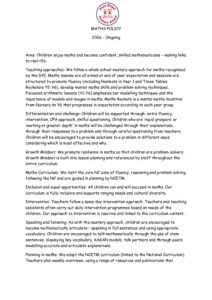
Maths Policy 2026
If you would like to know more about our maths curriculum, or about any other aspect of our curriculum, please contact the school office, who will be happy to direct your query.